
Big Hops Review | A Fresh 3D Platformer Masterpiece Blending Mario Precision and Zelda Adventure

Big Hops is an exemplary platforming adventure game that takes heavy inspiration from both 3D Mario and The Legend of Zelda series. Luckshot Games has demonstrated masterclass-level skill in combining the ease of control and quality of Mario platforming with the Zelda-style pacing and structure that were key to those 2000s classics. Big Hops manages to be more than the sum of its parts and stands out, rather ironically, as the most unique game I have played in recent memory.
Several things define Big Hops. Let’s begin with the story and structure of the game. We start as Hops with his family in the forest when suddenly a dark rift opens up and engulfs him. Naturally, we want to return to the forest and reunite with Hops’ family, and in order to do so, we are told to explore and collect pieces of some kind of dark matter. This task is given to the player by Diss, an entity from this Rift dimension who is responsible for these frequent rifts. Diss is presumably short for “Disrespect” because of his CONSTANT rude attitude and deluge of vexatious dialogue. What it should stand for is “Diss-Guy-Sucks”!
.jpg)
As abrasive as he is written to be, I have to acknowledge his part in the overall charm and identity that Big Hops builds throughout the game.
To speak of the story is to speak of the characters that Hops meets along the way. His main objective is supposed to be gathering the “dark drips” (or whatever) for Diss, but Hops is being held away from home against his will, and his true goal is to go home. To do this, Hops discovers that he will need to acquire parts to build an airship. This journey brings him into contact with a wide range of silly, sarcastic, or strange townsfolk, and each encounter is full of personality and quite enjoyable. Whether getting wrapped up in the punk-rocker band of bats, dealing with the somewhat pitiful airship mechanic, or meeting the other characters spread across three biomes -each segment of the game has a colourful, gorgeous, and most importantly, memorable identity.
That was a bit of an aside.
.jpg)
The unique and memorable attributes of Big Hops permeate the entire game, including the story and structure I was trying to describe. The story, in terms of objectives and motivation, is straightforward: Find the airship parts and return home to Hops’ family. Fend off Diss’ attempts to take advantage of you and stay the course through three unique biomes.
The structure of the game is very influenced by 2000s Zelda games and undeniably the classic video game rule of threes: three biomes, three airship parts. Each biome functions in the same way that a Zelda temple would; with a village and an area that will challenge your skills. Each of these “temples” consisted of three parts too! (“Turn on three generators,” “Find three X,” that sort of thing.) Then you face a boss fight. All of these were a lot of fun despite Hops lacking any sort of attack. The game is fairly long at 15 hours, and even towards the end I was pleased to be met with [again!] three challenges and a boss fight in a final act similar to Ganon's Castle in Zelda: Ocarina of Time. Even though Big Hops is structured like a Zelda game, it should be celebrated that Luckshot Games was so successfully able to subvert expectations and deliver an intense and creative puzzle-solving platformer in place of Zelda’s iconic puzzle-solving combat.
That brings us to the other major influence or the second parent in this equation: the Mario DNA.
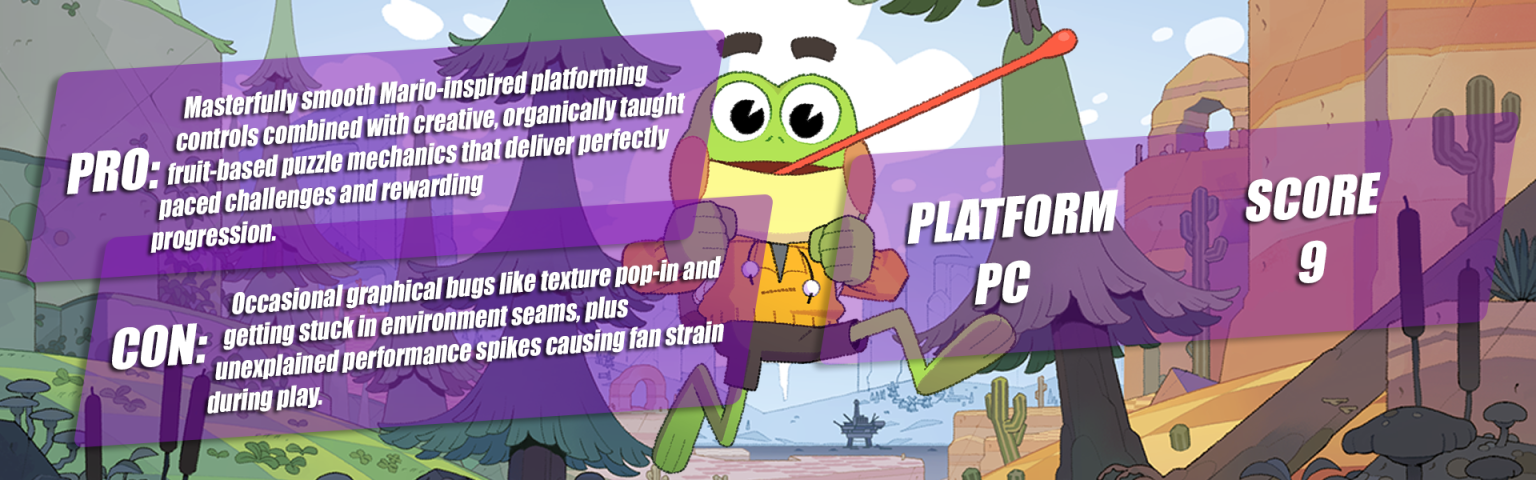
Undeniably, the best aspect and selling feature of Big Hops is the core gameplay. The Mario DNA can be felt in the controls and how buttery-smooth the motions can be. Within seconds I was learning how to move around with precision and speed in a comfortable way because it felt familiar somehow. Deep ancient memories of Mario 64 were recalled to the surface of my mind by the familiar “Hiip. Haap. Hoo!” three-step jump combo. Each jump feels good, has an accompanying sound, and always feels under control. That fundamental control is of the utmost importance because the adventure ahead is full of multistep puzzle-solving with various “fruit” items that alter the environment.
This is where the creativity behind Big Hops really shines.
.jpg)
The other Mario connection I can draw is that of utmost quality. The platforming in Big Hops is incredible, and the pacing and introduction of each mechanic are masterfully tailored. Those aforementioned fruits are the key ingredient in the Luckshot kitchen. In each biome, Hops will encounter many different situations that cannot be solved by the ever-trusty “Hiip. Haap. Hoo!” and each time, the solution is to find and utilize fruit in the area. Beginning with mushrooms [“fruit”] that turn into jumping pads, acorns that grow up into the sky like beanstalks, seeds that leave grapple points or set fire to obstacles -there are countless mechanics that the player has to learn to progress. This is all done without explicit instruction. The best part of the whole game is the learning experience with each fruit mechanic. In every instance, I was faced with a problem that could only really be solved in one specific way. That first introductory puzzle with each fruit was the perfect way to teach me in a way that felt truly rewarding. It feels as though the developers respect my time and don’t bog down the speed of gameplay with tutorial boxes. The game assumes that I am intelligent enough to learn the mechanics and then gives me an increasing toolset. As the toolset grows, so does the challenge/difficulty. The game is paced perfectly to first challenge the player to master one of the fruits and then knows when to move to the next, combining mechanics along the way until the obligatory boss-fight showdown. All of these platforming challenges form the geography of each biome, and they are each memorable and noteworthy in their own right. Luckshot Games has designed a gorgeous world immersed in the highest-quality gameplay and adorned it with charismatic and lovable townsfolk.
.jpg)
The game has serious moments and silly moments in equal measure, but unfortunately Hops the frog wasn’t able to eat all of the bugs…
.jpg)
I must take a moment to admit that there were some bugs. Most of them, funny enough, were eaten by Hops because he is a frog and eating bugs functions as health packs. However, I experienced a few annoying but not mood-killing bugs. My laptop is relatively good, and I noticed moments when the fan's RPM would climb sharply, as if to indicate that it was straining under load. This didn’t seem to match the amount of motion or action on screen at the time, but it would subside within a few minutes without harm. The real bugs were usually graphical in nature. The game has a very distinct art style and look to it, but I would see texture pop-in around the edges of objects in the environments sometimes, as well as some larger pieces of terrain. This was pretty rare, but on more than one occasion I found myself stuck in the seams of two pieces of a building, or where the ground meets a wall, etc. I was never trapped there or forced to reload the game, but I think that these bugs only happened in longer play sessions, and reloading the game may preemptively resolve them.
Big Hops left a great impression on me and subverted my expectations when it comes to platformers. What on the surface looked like a silly kids' game actually turned out to be one of the most creative and fun games I have played in a long time. The expertly crafted mechanics, plus the genius creativity and undeniable charm, make Big Hops an incredible experience.
Comments (0)